


Today, we present you a mid-term investment overview of the EUR/JPY pair.
The yen's growth prospects remain rather subdued even against the background of the active position of the Bank of Japan (BoJ): at the beginning of the year, the regulator changed the long-term policy of negative borrowing costs, raising the key rate from 0.10% to 0.25%, which had a supportive effect for the yen. Despite the increase in the cost of borrowing, the Japanese economy continued to slow down, so very unexpected is the latest report on gross domestic product (GDP), which recorded growth of 0.7% QoQ and acceleration from 2.4% to 2.9% YoY. Other key indicators are also in favor of positive dynamics: for example, household spending in annual terms in July added 0.1% after a decrease of 1.4%, and the consumer price index (CPI), which accelerated to 2.8% in June, in July amounted to the same 2.8%, suspending the positive dynamics observed for two years months in a row.
At the same time, investors are not sure about the intention of the European Central Bank (ECB) to sharply reduce the cost of borrowing. Analysts' forecast suggests that at the September 12 meeting, the key rate will be adjusted by 60 basis points, from 4.25% to 3.65%. Despite the slowdown in inflation, such a sharp reduction in rates may have a negative impact on consumer prices. For this reason, experts are considering a correction of 50 basis points, which will provide a more "soft landing" for the economy.
Thus, in the near future, the BoJ may carry out a number of key rate hikes, which will reduce the difference in monetary approaches, supporting the yen.
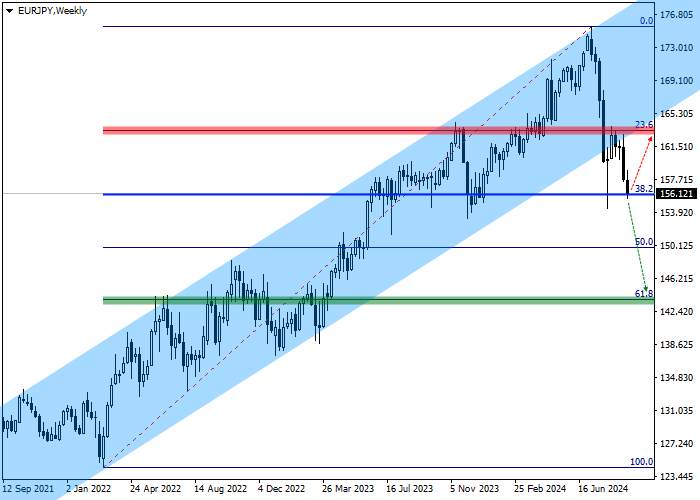
In addition to the underlying fundamental factors, the continued growth of the EUR/JPY pair is confirmed by technical indicators: on the W1 chart, the price continues its corrective decline as part of working out a wide ascending channel with the boundaries of 175.00–165.00 and moves downwards, reflecting from the support line.
EURJPY-1
At the moment, further strengthening of the downward dynamics may occur when consolidating below the level of the basic 38.2% Fibonacci retracement at 156.00.
Key levels can be seen on the D1 chart.
EURJPY-2
As can be seen on the chart, the current decline is an attempt to start a new trend and reach the level of a full 61.8% Fibonacci retracement at 143.80, after which a local correction can become a full-fledged trend with targets well below 140.00.
Near the level of the initial correction of 23.6% Fibonacci at 163.30, there is a zone of cancellation of the sell signal; if it is reached, the downward scenario will be canceled or significantly delayed in time, and short positions should be liquidated.
In the area of the basic 61.8% Fibonacci correction level, at around, 143.80 there is a target zone; if it reached, one should take profits on open short positions.
In more detail, trade entry levels can be evaluated on the H4 chart.
EURJPY-3
The trade entry level is located at 156.00, which coincides with the level of the basic 38.2% Fibonacci retracement, and a signal to start selling can be received today. Technically, overcoming the current local minimum will be implemented, which will open up an opportunity to enter the market.
Given the average daily volatility in the EUR/JPY pair over the past month, which is 987.5 points, the price movement to the target zone of 143.80 may take about 57 trading sessions, however, with increased dynamics, this time may be reduced to 48 trading days.
Peringatan: Pendapat yang disampaikan sepenuhnya merupakan milik penulis dan tidak mencerminkan posisi resmi Followme. Followme tidak bertanggung jawab atas keakuratan, kelengkapan, atau keandalan informasi yang disediakan, serta tidak bertanggung jawab atas tindakan apa pun yang diambil berdasarkan konten ini, kecuali dinyatakan secara tertulis.

Tinggalkan pesan Anda sekarang