


Tickmill Group
The U.S. Treasury market came under pressure again on Thursday as U.S. economic data continued to shine. Yields across multiple maturities remain near their highest levels since the 2008 financial crisis, a sign that bond investors believe the economic alarm has not yet been lifted.
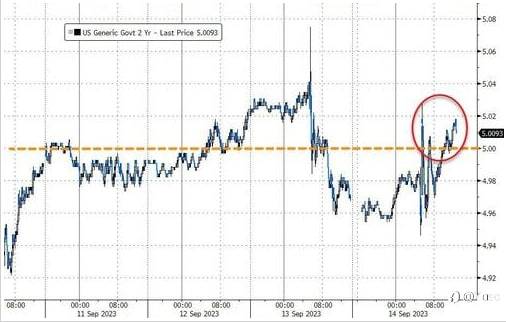
Market data shows that U.S. bond yields of all maturities rose on Thursday, reversing the previous day's decline. As of late New York trading, the 2-year U.S. Treasury yield rose 4.2 basis points to 5.024%, the 5-year U.S. Treasury yield rose 3.8 basis points to 4.427%, and the 10-year U.S. Treasury yield rose 3.8 basis points to 4.295%. , the 30-year U.S. Treasury yield rose 3.9 basis points to 4.385%.
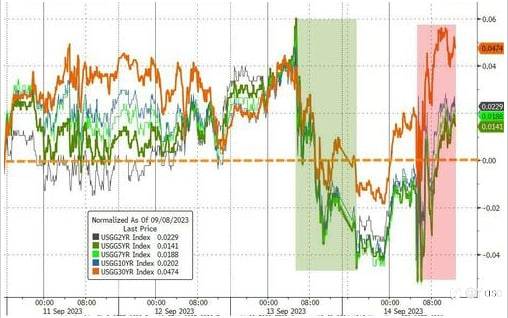
After experiencing repeated battles between long and short in recent trading days, the 2-year U.S. Treasury yield once again rose above the 5.00% mark overnight.
Tickmill
In terms of news, the retail sales and producer price index (PPI) data released by the United States on Thursday were both higher than expected, while the number of initial jobless claims also continued to remain at a low level, indicating that while the U.S. economy continues to show strong resilience, the future The possibility of a return to high inflation risks still lingers.
Sales at U.S. retailers rose 0.6% in August, with much of the increase tied to rising gas prices, data showed, despite sluggish sales at internet stores following Amazon.com Inc.'s Prime Day promotions. Retail sales account for about one-third of all consumer spending, so the performance of the U.S. retail sales indicator, known as the "horror data", often provides clues about the strength of the economy.
In terms of prices, the U.S. Producer Price Index (PPI), which represents final demand, rose 0.7% from the previous month in August. Gasoline prices soared by 20%, which was the main reason for the increase in PPI. These reports, coupled with Wednesday's Consumer Price Index (CPI), indicate that U.S. households and businesses are still feeling the impact of rising price costs.
Another data released on Thursday showed that the number of people filing for unemployment benefits last week remained low, indicating that companies are still unwilling to lay off workers. After adjusting for seasonal factors, the number of initial jobless claims in the United States for the week ending September 9 was 220,000, in line with market expectations.
Mike Loewengart of Morgan Stanley's Global Investment Office said, "Like last week, these data continue to paint a strong picture of the U.S. economy. The problem as always is that this may translate into stubborn inflation, and stronger-than-expected PPI data will It proves it.”
Loewengart added, "It is still possible that the Fed will remain on hold next week, but if the economy continues to unexpectedly rise, it is unclear what actions they will take after the last two policy meetings of the year, and another rate hike will certainly be on the horizon." On the table.”
Is the Federal Reserve expected to repeat the "Eagle Pause" drama next week?
In fact, with the recent series of hot economic data, it indicates that the "last mile" of the Federal Reserve's anti-inflation battle may become extremely bumpy. Many industry insiders have predicted that at next week's interest rate meeting, Federal Reserve Chairman Powell and His colleagues may avoid giving a signal that the current rate hike cycle is over.
JPMorgan Chase Chief Economist Bruce Kasman said, "Fed officials are unlikely to signal that the interest rate hike is complete now."
This will be in sharp contrast to the European Central Bank's interest rate decision on Thursday - although the latter announced a 25 basis point interest rate hike overnight, and President Lagarde refused to say whether interest rates have peaked, investors, based on the content of the interest rate statement, It has been basically judged that the bank's interest rate hike cycle has come to an end.
Therefore, in the eyes of traders, the message conveyed by the Federal Reserve next week is more likely to be similar to the "hawkish pause" at its June meeting, rather than the "dovelike rate hike" of the European Central Bank this week.
Kasman said the Fed's interest rate dot plot released next week is likely to show that officials' median forecast is still for one more interest rate hike this year, leaving open the possibility of a rate hike in November or December. Kasman added that Powell's remarks at the post-meeting press conference are likely to be subtle and may signal that the Fed is making progress in lowering inflation.
In addition, the Federal Reserve is expected to significantly raise its economic growth forecast next week. At the June meeting, officials’ median forecast for economic growth this year was 1%.
Tickmill Group
Peringatan: Pendapat yang disampaikan sepenuhnya merupakan milik penulis dan tidak mencerminkan posisi resmi Followme. Followme tidak bertanggung jawab atas keakuratan, kelengkapan, atau keandalan informasi yang disediakan, serta tidak bertanggung jawab atas tindakan apa pun yang diambil berdasarkan konten ini, kecuali dinyatakan secara tertulis.

Tinggalkan pesan Anda sekarang