

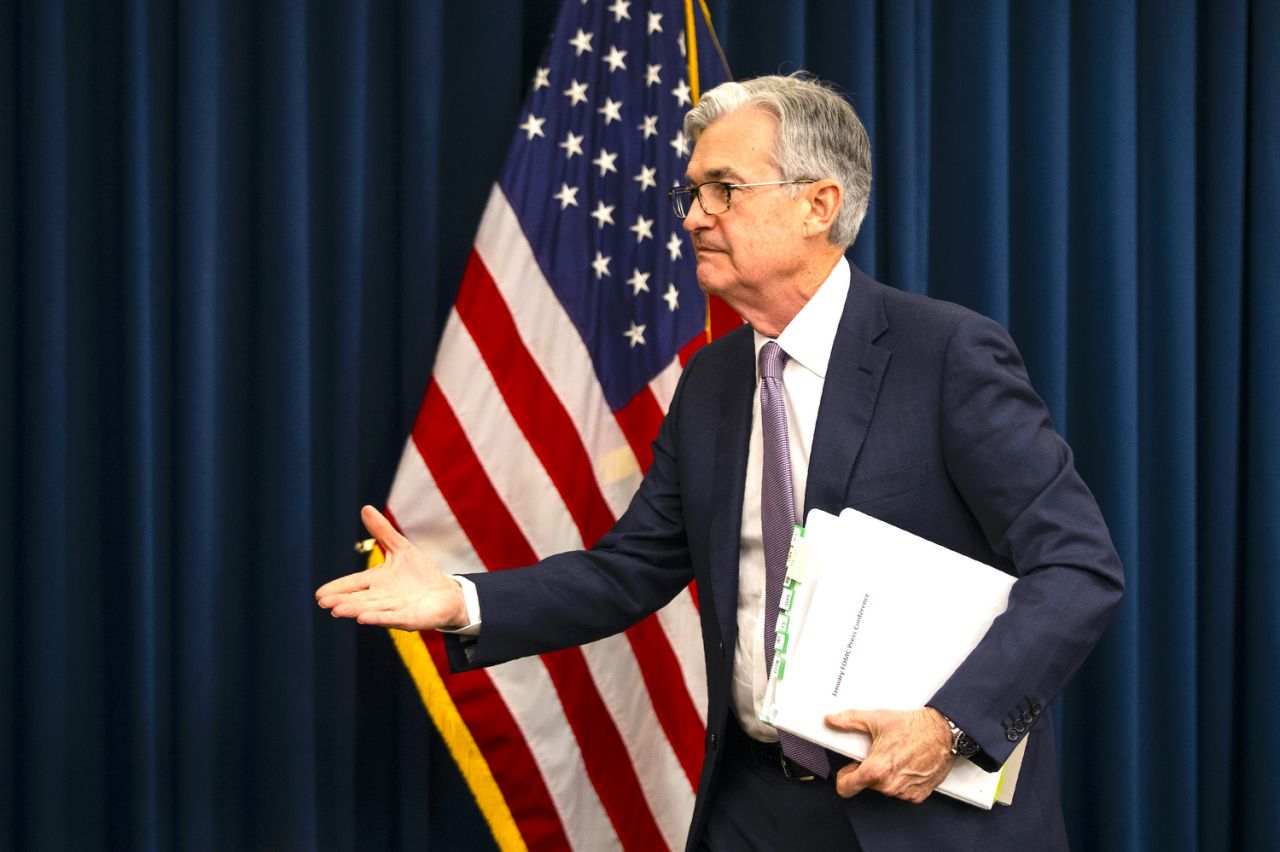
The Federal Reserve decided on Wednesday to hold interest rates steady at near-zero, signaling its intention to support a post-COVID economic recovery by keeping rates at the lower bound through at least 2022.
“We’re not thinking about raising rates,” Fed Chairman Jerome Powell said in a press conference. “We’re not even thinking about thinking about raising rates."
The Fed’s statement noted that financial conditions “have improved,” pointing to optimism over an economic recovery. In addition to keeping rates in its target range of 0% and 0.25%, the Fed statement also committed to increasing its asset purchases “over coming months.”
In a set of new economic projections, most of the 17 members of the Federal Open Market Committee appeared to support keeping the federal funds rate at the zero bound through the forecast horizon of 2022. In “dot plots” mapping out each members’ forecasts, only two policymakers saw a case for hiking rates in 2022 (one of which saw four rates hikes by the end of 2022).
By keeping rates low through at least 2022, the Fed hopes it will be able to steer the economy back to its pre-pandemic shape. The decision to hold rates at near-zero was unanimously agreed upon.
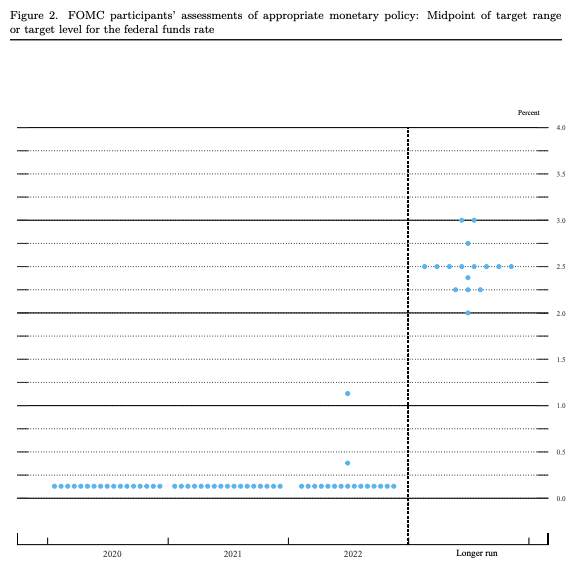
The FOMC’s forecast on key economic indicators suggest that those within the central bank expect a gradual recovery.
The median FOMC participant still expects real GDP contracting by 6.5% in 2020 with the unemployment rate at an elevated level of 9.3% by the end of the year. But in 2021, the median projection has unemployment falling to 6.5% and real GDP rebounding by 5.0%.
Some positive signs already arrived in the form of last Friday’s jobs report, which showed unemployment ticking down as 2.5 million jobs were added back to the economy.
Despite unprecedented fiscal relief and the Fed’s ballooning balance sheet, Fed officials do not expect inflation to meaningfully appear. The median FOMC policymaker forecasts low inflation (as measured in core personal consumption expenditures) of just 1.0% in 2021, rising moderately to 1.5% in 2021. The central bank’s inflation target is 2%.
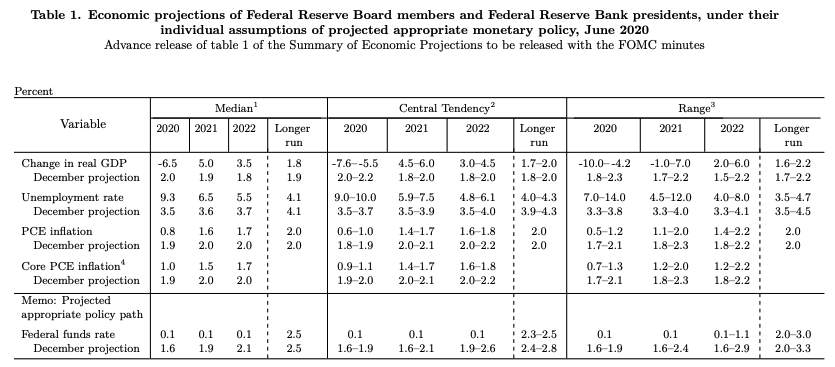
The Fed’s statement reiterated its commitment to “use its tools and act as appropriate to support the economy.”
The Fed’s economic projections are usually released quarterly but because the central bank skipped its March release amid its emergency meetings, meaning that the forecasts released today are the Fed’s first for 2020.
Forward guidance?
Although the policy statement and economic forecasts provide some details on the central bank’s interest rate policy, the Fed still has yet to explicitly message its medium-term plans on monetary policy.
With longer-term interest rates on the rise, the Fed may face pressure to offer forward guidance to nudge the market into pushing borrowing costs lower. One way the Fed could do this would be committing to keeping rates low until the unemployment or inflation rate reaches a specific level. The Fed could also outline a specific pace of asset purchases under its quantitative easing program.
A more direct way to lower borrowing costs would be purchasing U.S. Treasuries until the yield curve flattened to desire levels. The central bank has discussed a form of yield curve control in which the Fed purchases medium-term government debt (such as 3-year or 5-year Treasuries) until yields fall below a stated target.
Reprinted from Yahoo Finance, the copyright all reserved by the original author.
Peringatan: Pendapat yang disampaikan sepenuhnya merupakan milik penulis dan tidak mencerminkan posisi resmi Followme. Followme tidak bertanggung jawab atas keakuratan, kelengkapan, atau keandalan informasi yang disediakan, serta tidak bertanggung jawab atas tindakan apa pun yang diambil berdasarkan konten ini, kecuali dinyatakan secara tertulis.

Tinggalkan pesan Anda sekarang